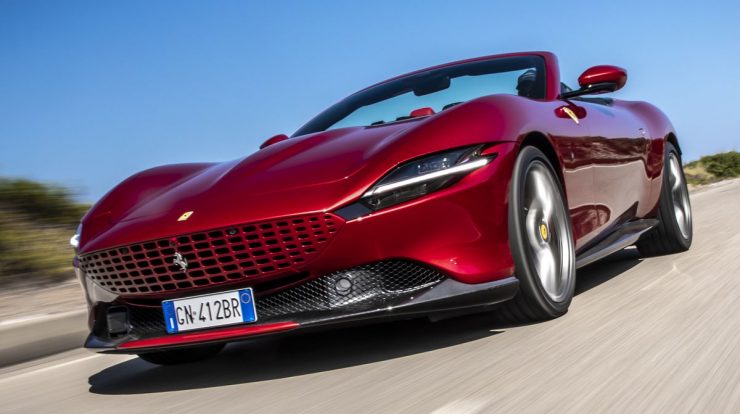
A day blasting around the most spectacular roads on the equally spectacular Italian island of Sardinia in the new Roma Spider raises a simple question: did Ferrari really need to try this hard? This the slowest and second-cheapest car in its range. Isn’t it just the Ferrari for people who can’t afford a better one?
Because it isn’t long since entry-level Ferraris–a term the company hates, by the way–did feel primarily intended as a reason to dig deeper. The 2009 California that sits higher in the Roma Spider’s family tree was originally intended to be launched as a Maserati before then-parent Ferrari decided to promote the project to the A-team. With its gawky folding hardtop and porky curb weight the Cali was the least dynamic car in the range, by some margin, and felt like a luxury label’s diffusion line. Yet it was also a huge success, the best-selling Ferrari of all time at that point, making the decision to extend the bloodline an obvious choice.
Even if buyers liked the California, Ferrari clearly felt the need to improve its successors. The turbo’d California T was upgraded to what was basically a front-mounted version of the 488’s engine, while the 2018 Portofino got a lighter aluminum structure and an electronically-controlled limited slip differential. Now the Roma Spider is here with close to a full set of go-faster, go-harder acronyms: Variable Boost Management for the turbos, F1 Traction Control, third-gen double-clutch E-Differential, the SCM-E twin-solenoid active dampers which made their debut on the LaFerrari. It even has the drift-curating Side Slip Control.
The Spider’s engine and transmission are identical to the coupe: a 3.9-liter twin-turbo V8 making 611 hp, delivered to the rear axle through an eight-speed twin-clutch transmission that’s based on the one on the SF90 Stradale, but with a mechanical rather than electrical reverse gear.
The dynamic tech can impress later. The most significant change is the most obvious one – the Roma Spider’s power-operated fabric hood. This makes it the first front-engined Ferrari softtop since the 1969 365 GTS/4, but it also makes it look much better than its predecessor’s lumpy retractable hardtops. The Spider is handsome with the roof in place, and outright gorgeous with it lowered. Nor, apart from money, is there much of a price to pay for choosing the Spider. On Ferrari’s numbers, it is 185 lbs heavier than the coupe and the engineering team admits it is slightly less rigid. But the claimed 3.4-sec 0-62 mph time is identical for both cars, and the Spider’s 9.7-sec 0-124 mph time is just 0.4-sec adrift of the coupe’s official time.
Look at it another way—how far back in time would you need to travel until 2023’s slowest Ferrari would be the quickest car in the range? Not outside this century, certainly for straight-line acceleration. Nor is the Spider markedly less practical than the coupe, keeping two almost-seats in the back to boost the limited practicality of the small trunk. (It has a moveable partition to ensure there is enough room for the roof to be stored.) Only the smallest, squashiest, and most willing occupants will be able to squeeze in back, but the extra room more than doubles bag space.
The Spider’s driving experience is proof that Ferrari wants to both please and flatter its audience. Those in search of a luxurious cruiser for low-intensity use and showing off will find one by the simple expedient of leaving the steering wheel’s twistable Manettino switch in its Comfort position. That keeps the Spider’s chassis feeling GT-plush over bumps and leaves the double-clutch gearbox doing a good impression of a torque converter auto when in Drive. Cruising refinement stays good with the roof lowered, a power-operated pop-up wind deflector springs from the rear seat backs to reduce buffeting. With the roof up—a transformation that can be made on the move at speeds of up to 40 mph—it feels pretty much as snug and well-insulated as our memories of the coupe.
Don’t worry, there is another Roma as well, one that feels much more like a traditional Ferrari. Flicking the Manettino to Sport puts an immediate edge on the ride as the active dampers firm up, adds some artfully synthesized shock to transmission upshifts and, most significantly, changes the behavior of the smart active differential. Pushing hard in Comfort will ultimately bring the sensation of the front Bridgestone tires starting to edge wide; understeer is too harsh a word for what is basically dynamic shorthand for ‘that’s about it’ delivered in the most unobtrusive way possible.
But Sport reverses the handling balance, eliminating this front-end push and giving much more latitude to the rear axle. The front end remains supremely pointable and willing to lock onto a chosen line; steering is quick and direct yet doesn’t suffer from corruption over bumps. From there, even with the stability control fully engaged, the Spider can be pushed into oversteer in slower and tighter turns. It feels heroic and hugely exciting—who doesn’t love the feeling of nearly spinning a Ferrari?—but the various dynamic systems are still working invisibly in the background to maintain order.
While the Manettino’s further Track position might seem excessively keen for the Spider, it is really a full drama mode rather than one likely to be called on for regular circuit work. This puts iron into the suspension, gives the fastest possible gearshifts, and allows the engine to sing with the exhaust’s electrically controlled bypass valve fully open, turning the engine’s sonorous 7500 rpm redline into a target rather than any kind of limitation. And it sounds even better with the roof down.
There were still some surprises. Driving European-market cars meant the unlikely need to deal with a full battery of officially mandated ADAS active safety systems. This was a Ferrari that pinged admonition whenever it broke a speed limit and applied steering inputs when it thought it was leaving its lane; even on empty mountain roads. Fortunately, it could all be turned off relatively easily and we’re told that U.S. cars will have a much less intrusive version. Ferrari’s determination to put every driving control somewhere on the steering wheel continues to create ergonomic confusion, especially with the main beam flash and one-time wiper functions now miniature triggers behind the wheel, and turn signals separate buttons on top. Would it really be heresy for something as GT-ish as the Roma to be allowed to return to stalks? Or am I shouting at clouds here?
The Roma Spider is proof that Ferrari can’t do average anymore. The company puts massive effort into everything it does, even when it means creating a car that has vastly more capability than most of its owners are ever likely to call upon. It is not as fast or as nimble as its more expensive siblings, but even the slowest Ferrari in the range now feels like a high point.