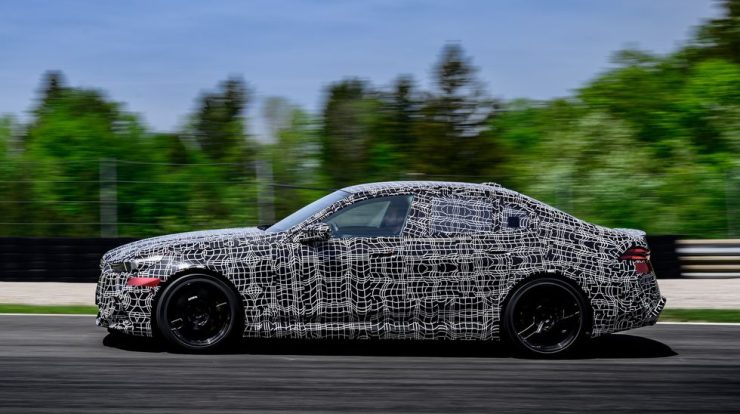
No, it’s not an electric vehicle, but it is a plug-in hybrid. Yes, a hybrid M5—but where many manufacturers are using motors and batteries to make up for the never-ending downsizing of displacement in their performance machines, BMW is taking a different approach.
Just like the outgoing M5, the upcoming 2025 M5 features a twin-turbo 4.4-liter V8, which makes nearly the same output as before. Specifically, it delivers 577 to all four wheels, down 23 from the current model. Then there’s the new player, an electric motor attached to the transmission that brings another 194 hp to the table. BMW says total maximum system output of the two combined is of 717 hp and 738 lb-ft of torque. That’s a lot of shove, but it comes with a penalty.
It’s an unfortunate inevitability that subsequent generations of a car are almost guaranteed to gain weight, but a plug-in-hybrid system with a big battery means a substantial mass penalty over the outgoing version. Is it worthwhile? Let’s run through all the changes, then I’ll take you for a few hot laps to find out.

The 2025 M5 packs big power, mid-size battery
If a 4.4-liter V-8 with a plug-in-hybrid system sounds familiar, that’s because it’s largely the same setup found in BMW’s XM. But where that system in the curiously proportioned SUV carries a 19.2-kilowatt-hour battery, the new M5’s system is substantially smaller, offering just 14.8 kWh of usable capacity.
That helps to save some amount of weight on the M5, at least, but that pack still carries enough lithium ions to let the M5 do 43 miles per charge on the WLTP cycle. (That will probably be closer to 30 miles on our EPA test cycle.) It will surely also boost the overall efficiency of the machine, but we’ll have to wait for the EPA to finish doing its business to see by how much.
The electric motor’s positioning on the eight-speed automatic transmission means it can select from all the available ratios, powering the car at up to 87 mph without emissions.
Yes, it’s an automatic. No, a manual isn’t available—but don’t worry, this isn’t your typical slushbox, it’s BMW’s fast-acting eight-speed M Steptronic transmission. That transmission spins BMW’s Active M Differential differential at the rear, part of the standard xDrive all-wheel-drive package that enables acceleration from zero to 62 mph in 3.5 seconds, three-tenths slower than the outgoing car. Top speed is limited to 155 mph per usual, but pick the right options package, and that can be raised to 190.

Helping the handling
When it comes to speed, the extra power offered by the hybrid system largely makes up for the extra weight—but making the car handle properly is another matter entirely. To help with turning, that rear differential can vector torque left to right, as in the previous M5. Here, it’s been augmented with a standard rear-axle steering system, which BMW calls Integral Active Steering.
Interestingly, where Mercedes-Benz machines proudly offer up to 10 degrees of rear steering depending on your wheel package, giving the S-Class disorienting nimbleness, BMW’s system offers only 1.5 degrees at the rear axle. “The best function of the rear-wheel steering is if you don’t feel it,” Dirk Häcker, head of development at BMW M Automobiles, told me. Translation: He didn’t want his cars to feel like a forklift.
The most important part of the equation, though, as ever, is the tires. Measuring 285/40/20 at the front and 295/35/21 at the rear, the staggered rubber is wider than before. A range of available tire models from Michelin, Pirelli, and Hankook will be available, depending on wheel package and buyer location.
Keeping those wide wheels enshrouded required some extensive bodywork. The M5 sits nearly three inches wider up front than a regular 5 Series. The fender flares are more subtle than those on an Audi RS 5 or RS 6 Avant, but the purposeful stance is strong. Stronger, though, is the massive intake that sits low on a nose that is less controversial than many of BMW’s other current offerings. Out back, a giant diffuser surrounds the quad-exhaust setup on the new M5, while a subtle lip spoiler runs across the trunk’s trailing edge.
That can be optionally had in carbon fiber, as can the roof and the mirror caps, a package that saves 75 pounds over the standard glass roof. Optional carbon-ceramic brakes save another 55 pounds. They also proved immensely capable on the track.

The new BMW M5 at speed
I don’t hit the M5’s top speed of 190 mph on the Salzburgring, but I repeatedly top 170 on the track’s back straight … which is anything but straight. Coming out of a tight corner with all the banking of Talladega, you fire of that right-hander onto a three-quarter-mile stretch of asphalt that weaves left and right with enough severity that you can’t see the eventual corner you need to slow for until you’re well past the braking point.
It’s one of those situations where your brain is screaming for you to lift, but doing so would likely send you spinning into the walls, which stand just a few feet off the racing service to the left and the right. You don’t have to look too hard to see fresh tire marks on the asphalt from poor souls with lighter feet and dispositions.
So, foot shaking but staying on the floor, I watch as the M5’s gauge cluster counted up to 280 km/h lap after lap—so fast that I threatened to climb in the back seat of the instructor’s M4 CS I was chasing around. At that speed, the M5 is eminently stable despite the uneven asphalt flashing beneath me.
The compliance of the suspension is a real marvel, something helped by the sedan’s actual sidewalls. While most sport sedans are saddled with millimeter-thin tire profiles, an aesthetic choice that surely has caused many sleepless nights among suspension engineers, the M5 carries slightly more generous tires.
“Some think the smaller the better. But that’s not right,” Häcker said, citing generous sidewalls on race cars from GT3 to Formula 1. Bigger sidewalls, he said, improve the damping characteristics of the car without any real drawbacks. “You can’t feel the high sidewall when turning. It’s very stable, it’s very precise, and it works quite well.”
This is easily tested on the track’s curbing. Though fast and flowing in the middle, the beginning and end of the lap at the Salzburgring offer plenty of opportunities for curb-hopping. The M5 is so prodigiously good at this, I thought maybe the track had only petite sections of concrete defending its corners.
A few fast laps in an M4 CS quickly cure me of that misconception. Where both sides of the M4 are launched skyward when taking an ideal line through the track’s first chicane, the M5 simply charges on through with practically no disturbance felt from behind the wheel. (Speaking of, the M Servotronic variable-ratio steering helps me swing the car through tight sequences without shuffle-steering.)
Despite its increased weight, there’s little body roll to contend with in the M5. It stays flat and smooth through the turns, and I didn’t have to wait long for the suspension to settle before hitting the brakes at the end of that long straight.
I do, however, need to be a little patient getting back on the throttle through the final, decreasing-radius turns that mark the end of the circuit. There is, I’m sorry to say, plenty of understeer at play in the M5. The rear steering surely helps with stability at high speed, and I’m sure it’s also making a noble effort at helping the M5 turn, but the combined efforts of that and the torque-vectoring rear differential couldn’t help me get the nose where I wanted it.
I try all different ways to cure that behavior, including adding more throttle in the hope that the rear diff would vector me back toward the apex. This technique works well on the smaller, lighter M4—not here, adding throttle just makes the situation worse. The only solution I find is the traditional one: Lift off the accelerator and unwind the wheel. Don’t get me wrong, the M5 carries incredible speed and grip through those corners, especially for something so generously roomy as this … but those front tires paid the price. After pulling into the pits after a six-lap session, I lay my hand across the surface area of the left front tire and get a scalded palm in return. That outer edge was working overtime.

A next-generation ‘Bahnstormer
Though I sadly was not able to sample the M5 on the autobahn, its eminent smoothness at speed on the track undoubtedly means it’ll be a weapon there. Meanwhile, the compliance I felt over the curbs is good news for anyone who’ll be wheeling these through areas with broken asphalt. Yes, the understeer on those few turns at the track that overloaded the front rubber was a bit unfortunate, but it was only when pushing the car at the extreme limit that the tendency arose. If you’re going that hard on the street, you have other problems.
The 2025 BMW M5 is more than track capable, yet it feels best suited for those long-distance runs that have been the hallmark of the M5 since its inception 40 years ago. Add on the extra efficiency and practicality that a plug-in-hybrid system offers—not to mention the delightful return of the long-roofed version to the American market—and you have a sharply tailored weapon that will inspire sheer lust in enthusiasts of all ages, just like it always has.